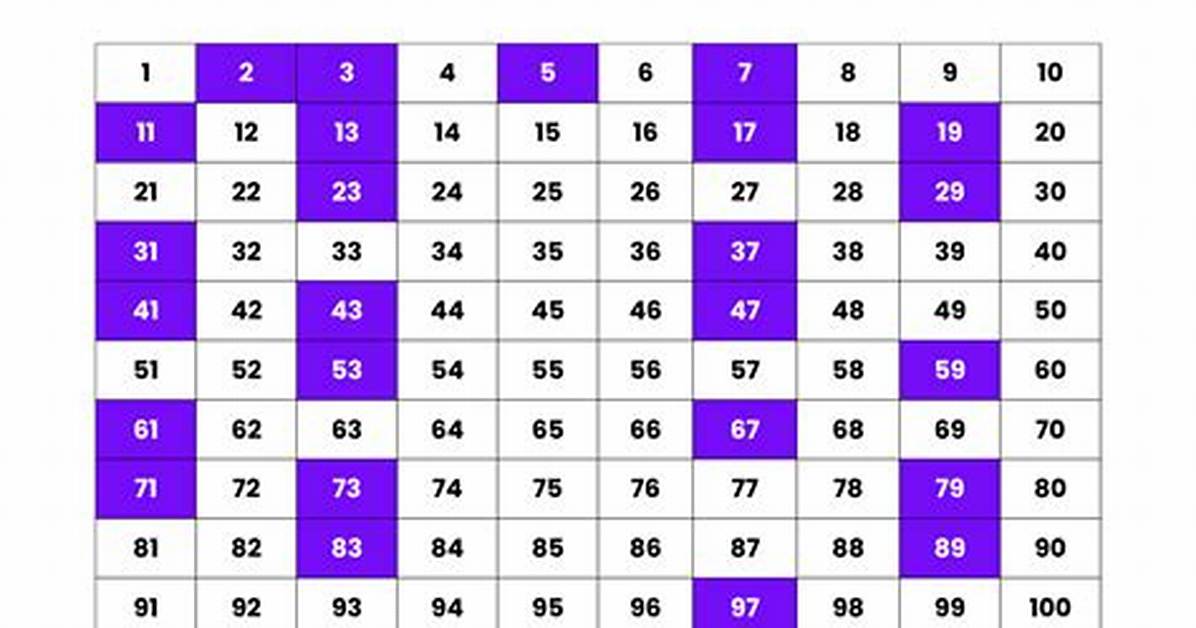
Prime numbers have fascinated mathematicians, scientists, and curious minds for centuries, serving as the building blocks of the number system. Their unique properties and intriguing patterns offer a glimpse into the underlying structure of mathematics. As we delve into the world of prime number patterns, we will uncover the relationships, sequences, and theories that have emerged around these enigmatic numbers. With each discovery, we come one step closer to understanding the deeper significance that primes hold in both mathematics and nature.
From the ancient Greeks, who meticulously studied prime numbers, to modern-day cryptographers relying on their properties for secure communication, prime numbers have played a pivotal role in various fields. Patterns such as the distribution of primes and their occurrence in different mathematical contexts reveal a rich tapestry of interconnected ideas. Join us as we explore the fundamental questions surrounding prime number patterns and what they mean for the future of mathematics.
In this article, we will discuss various aspects of prime number patterns, including their historical significance, mathematical theories, and applications in real-world scenarios. We’ll also examine some of the most compelling questions that arise from this fascinating topic, inviting readers to engage with the material and think critically about the nature of prime numbers. Whether you are a seasoned mathematician or a curious beginner, there is something for everyone in the world of prime number patterns.
What Are Prime Numbers and Why Are They Important?
Prime numbers are defined as natural numbers greater than 1 that have no divisors other than 1 and themselves. This means that a prime number can only be divided evenly by 1 and the number itself, making it unique in the realm of integers. The first few prime numbers include 2, 3, 5, 7, 11, and 13. Prime numbers are essential in various fields, including number theory, cryptography, and computer science.
How Are Prime Numbers Distributed?
The distribution of prime numbers has been a subject of extensive research. The Prime Number Theorem gives insight into how primes are distributed among integers. It states that the number of primes less than a given number \( n \) approaches \( \frac{n}{\log(n)} \) as \( n \) increases. This theorem highlights the irregular yet discernible pattern in the distribution of prime numbers, emphasizing that while they become less frequent as numbers grow larger, they never completely disappear.
Are There Patterns in Prime Numbers?
Despite being seemingly random, numerous patterns and conjectures exist regarding prime numbers. Some notable patterns include:
- **Twin Primes:** Pairs of primes that are two units apart, such as (3, 5) or (11, 13).
- **Goldbach's Conjecture:** The idea that every even integer greater than two can be expressed as the sum of two prime numbers.
- **Prime Gaps:** The difference between consecutive prime numbers tends to increase, but the exact behavior of these gaps is still an open question.
What Are Some Historical Perspectives on Prime Numbers?
Prime numbers have intrigued mathematicians for thousands of years. Early studies can be traced back to the ancient Greeks, particularly Euclid, who demonstrated that there are infinitely many primes. The exploration of prime numbers continued throughout history, with notable contributions from mathematicians like Eratosthenes, who developed the Sieve of Eratosthenes algorithm for finding primes, and Fermat, who conjectured about the properties of primes in his work.
How Do Prime Number Patterns Relate to Modern Technology?
In today’s digital age, the importance of prime numbers has only grown. Cryptography, the practice of securing communication, relies heavily on the properties of prime numbers. Algorithms such as RSA encryption use large prime numbers to create keys for secure data transmission. The security of online transactions, personal data, and confidential communications hinges on the unique characteristics of prime numbers, making their study not only a mathematical pursuit but also a crucial aspect of modern technology.
Can We Predict Prime Numbers?
While there are certain formulas and algorithms that can generate primes, predicting the exact occurrence of prime numbers remains elusive. Researchers have developed various conjectures and methods aimed at predicting primes, but a comprehensive prediction formula has not yet been discovered. The unpredictability of prime numbers adds to their allure and significance in mathematical research.

